How to Build a Loyalty Rewards Program
Loyalty points are one of the biggest untapped growth levers for racquet sport facilities. Your players already love games, progress, and leveling up. They track DUPR, climb league ladders, chase their next rating. A well-designed rewards program doesn't feel like a coupon to them. It feels like another game running on top of their game.
This post walks through the 6 rules we've developed for a high-performing loyalty program at a racquet sports facility: how to use points to pull in new players, turn drop-ins into weekly regulars, fill off-peak hours, and raise average spend per visit. It's drawn from what we've seen working (and not working) at the facilities we power around the world, combined with lessons borrowed from the restaurant and retail playbooks (airline programs, Starbucks, Domino's, the usual suspects), since business strategy is ultimately universal. At the end, we'll show how BookThisCourt's built-in loyalty and reward store makes this easy to run.
Why Loyalty Is a Cheat Code for Court Facilities
Loyalty done well gives your facility four things at once:
- A gamified layer on top of a game players already love. Points, tiers, and progress bars aren't a gimmick to competitive players. They're native.
- A referral engine. Guest passes and bring-a-friend rewards turn your existing base into your cheapest acquisition channel.
- Off-peak demand steering. An empty 10am Tuesday court is worth nothing to you. Turning it into a reward redemption costs nothing and builds a habit.
- A reason to book direct. Every point earned on your site is a booking that didn't go through a marketplace taking a cut.
The underlying fit is simple: your capacity is fixed but your demand isn't, your customers are already repeat by nature, and a free off-peak hour costs you almost nothing but feels like a real reward.
The 6 Rules of a Profitable Loyalty Program
Rule 1: Use Points, Not Cash Discounts
Points and cash discounts look similar on the surface, but they do very different things to player behavior.
A cash discount like "$100 off your next 10 hours" is a one-shot transaction. The player takes it, uses it, and moves on. There's nothing pulling them back tomorrow.
A points-based system, modeled after how airline and Starbucks chain programs work, creates an ongoing relationship:
- Every booking earns points.
- Points accumulate over time.
- Points unlock specific, controlled rewards that players choose.
The psychology matters. Points feel like progress. Players check their balance the same way they check their DUPR. They book an extra session just to hit the next tier. A dollar discount does none of that. It's a transaction, then it's over.
Rule 2: Stock the Reward Store with High-Perceived, Low-Cost Items
The best rewards feel valuable to the player and cost your facility almost nothing. Your reward store should be a curated menu of exactly these.
Great redemption options for a racquet facility:
- Off-peak court hours. A free 10am Tuesday hour feels generous to the player and uses capacity that was going to sit empty anyway.
- In-house drinks. A coffee, smoothie, or bottled water from your front desk cooler costs you pennies but feels like a real perk. A low-point-cost drink is also the perfect starter reward to get players hooked on redeeming.
- Equipment rentals. Paddles, racquets, ball machines.
- Stringing or regripping (tennis clubs).
- A sleeve of balls or a can of pickleballs.
- Pro shop merch. Branded shirts, hats, towels. Doubles as walking advertising.
- Guest passes. Bring a friend for free. One of the most powerful rewards you can offer, because it's also a zero-cost customer acquisition channel. Every guest pass redeemed brings a new player through your doors.
- Clinic or league entry. A great way to fill seats in programs you're already running.
What to keep out of the reward store:
- Peak-hour bookings. These book themselves, no incentive needed.
- Cash off anything. Defeats the point of having a points system in the first place.
Design your reward store so the player thinks "that's a great deal" and you think "that costs me almost nothing, and it brought them back."
Rule 3: Gamify the Experience, Lean Into What Your Players Already Love
This is where court facilities have a massive advantage over every other industry running a loyalty program. Your customers don't just tolerate gamification — they seek it out. They play a sport. They rank themselves. They chase their next rating bump. Layering a points game on top of all of that is the most natural fit imaginable.
The underlying psychology is completion bias: people are wired to finish things they've started. Your job is to make sure players always feel like they're almost to the next thing.
Practical ways to gamify:
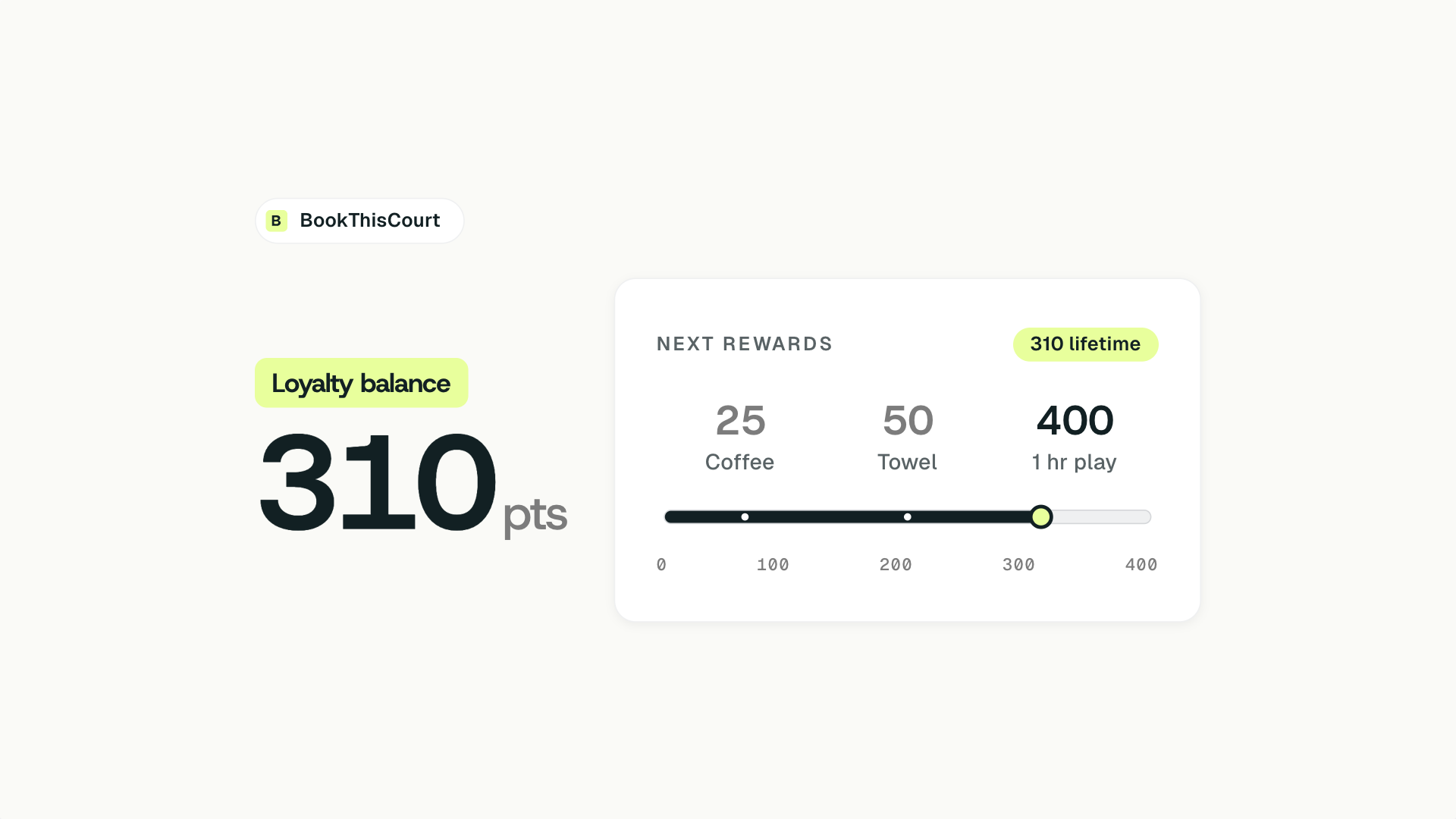
- Progress bars. Show players how close they are to their next redemption. Put it front and center on their account page.
- Laddered redemption tiers. A 50-point coffee, a 200-point off-peak court hour, a 400-point anytime hour. Each tier a player hits unlocks something visibly better, which pulls them toward the next one.
- Challenges and streaks. "Book 4 weeks in a row, earn a bonus reward." "Play 10 hours this month, unlock a free guest pass."
- Leaderboards. Post monthly top earners on a screen at the club. Competitive players will fight to be on it.
- "You're 50 points away" nudges. Send these by email or SMS after every few bookings.
A player sitting at 170 points who knows a free coffee kicks in at 200 will add one more session to close the gap. One extra booking per month across your active base is the kind of compounding growth that makes loyalty programs pay for themselves many times over.
Rule 4: Use Reciprocity to Raise Average Spend
Here's a counterintuitive win: players who redeem a free reward usually spend more on that visit than players who paid full price. It's called the reciprocity effect. When someone gets something for free, they feel compelled to give a little back.
Lean into it:
- Pair a free court hour redemption with a prompt to rent a ball machine for $10.
- Offer a "complete your session" upsell: towel service, a drink, a string job.
- Suggest a paid extension when their redeemed session is ending.
- Pre-book their next session at checkout with a small points bonus.
A redeemed free hour isn't a cost. It's a lead magnet for everything else you sell during the visit.
Rule 5: Automate the Reminders
The strongest loyalty programs keep the customer's point balance in front of them without being annoying. At minimum, your program should automatically:
- Confirm points earned after every booking.
- Nudge members when they're close to a redemption.
- Remind inactive players that their points are waiting.
If you're running this manually from a spreadsheet, it won't happen. This is why a rewards program that lives inside your court booking software, and pulls booking data automatically, is dramatically more effective than a punch card or a standalone app.
Rule 6: Use Scarcity and Expiration to Drive Action
"Points never expire" sounds generous, but it actually flattens the whole program. Nothing is urgent, nothing is special, and players forget they're enrolled.
Instead, use scarcity and expiration as built-in action triggers:
- Expire points after 6 or 12 months of inactivity. This reactivates dormant players before they're fully gone.
- Run limited-time redemption boosts like "This week only: 2x points on weekday mornings." Instantly fills off-peak hours.
- Give rewards a short window: "Your free hour expires in 14 days." Turns a sitting reward into a booking this week.
- Release seasonal rewards (a limited-run holiday paddle, a summer doubles tournament entry) that players can only claim during a set window.
Loss aversion, the feeling of losing something you already have, is roughly twice as powerful as the appeal of gaining something new. A player with expiring points will book just to avoid losing them. That's free demand you've manufactured out of thin air.
A Simple Loyalty Program Structure You Can Steal
If you want a starting template, here's a structure that works for most pickleball, padel, and tennis clubs:
- Earning: 1 point per $1 spent on bookings. Members on higher-paying plans earn points at a faster rate.
- Redemption ladder:
- 50 points → coffee or bottled drink from the front desk
- 200 points → off-peak court hour
- 400 points → any-time court hour
- 600 points → bring-a-friend guest pass
- 800 points → paddle or racquet rental for a month
- Expiration: Points expire after 12 months of inactivity. Redeemed rewards must be used within 30 days.
- Reminders: Automated email after every 3rd booking showing current balance and next reward.
This is simple enough for a player to understand in 10 seconds and structured enough that every redemption pushes them toward booking again.
Where This Typically Breaks Down
Even with the right design, most clubs stall on execution. The usual culprits:
- Tracking it manually. Punch cards, spreadsheets, and hand-stamped loyalty cards don't scale past your first 50 active players.
- A points system that lives outside the booking flow. If players have to remember to "check in" somewhere to earn, they won't, and the program dies.
- No automated comms. Points that no one mentions may as well not exist.
- Reward catalogs that never update. A static reward store gets stale. Change it quarterly.
Every one of these is a software problem. If your court booking system doesn't have loyalty built in, you're either running a watered-down version of a program or you're not running one at all.
How BookThisCourt Handles Loyalty Out of the Box
BookThisCourt is one of the only modern court booking platforms with a built-in loyalty and reward points system. Not a bolt-on, not a third-party integration. This is a gap in most legacy sports facility management software, and it's one of the biggest reasons clubs switch to us.
Here's what that looks like in practice:
- Automatic point accrual on every booking, gift card purchase, and credit pack sale.
- Tiered earning rates tied to your membership plans, so higher-paying members earn points faster.
- A customizable reward store where you choose the redemption options and their point costs: coffee, free hours, rentals, merch, guest passes, whatever fits your club.
- Automated reminders and balance notifications, so players always know how close they are to their next reward.
- Expiration and scarcity controls for points and redeemed rewards.
- Full reporting so you can see exactly which rewards are driving bookings and which aren't.
Because it's built into the same platform as your bookings, memberships, and credit hours, every part of the program runs on autopilot. No separate loyalty app, no manual tracking, no third-party monthly fee.
Bottom Line
A loyalty program is one of the most effective things you can bolt onto a court-based business. You're starting with a clean slate and a customer base that's already wired for games, progress, and leveling up.
A strong program at a racquet facility:
- Uses points, not cash discounts, to create an ongoing game instead of a one-shot transaction.
- Redeems for low-cost, high-perceived-value items like coffee, off-peak hours, and guest passes.
- Gamifies progress with a laddered redemption structure, streaks, and challenges your players will actually care about.
- Uses reciprocity and scarcity to raise average spend and drive action.
Run it well and you'll see more new players (through guest passes), more weekly regulars (through the redemption ladder), fuller off-peak hours (through steered redemptions), and higher average spend per visit (through reciprocity), all while your platform handles the bookkeeping on autopilot.
Try It Now For Free -> and start turning your casual players into regulars in a single afternoon of setup.
Related Posts
Continue reading with these related articles.
August 18, 2026
HOA Court Booking Software for Community Courts
How homeowners associations move tennis, pickleball, basketball, or any community court online, giving each household hours every month with no credit card.
August 18, 2026
Private Club Court Booking and Membership Software
How private tennis, pickleball, squash, and basketball clubs run members-only court booking, with a plan for each type of member and dues still collected their own way.
August 2, 2026
Best Court Booking Software in 2026: 6 Platforms Compared
Compare the best court booking software for tennis, pickleball and padel facilities in 2026: real pricing, strengths, trade-offs, and which platform fits your club.